

The donations helping to train the next generation of healthcare professionals
Marking a milestone anniversary for UOW’s Body Donation Program
December 11, 2025
For 20 years, selfless local donors have been facilitating vital anatomy lessons, allowing theory to become reality for medicine and health students through UOW’s Body Donation Program.
*Please note: This story contains discussion of body donation for teaching and research purposes, which may be distressing for some readers.
Each week, 1200 students pass through the anatomy lab at the University of ÌìÃÀ´«Ã½ (UOW), directly benefitting from the decision made by an anonymous stranger to donate their body for medical education and research after they have passed away.
Since UOW established its Body Donation Program in 2005, thousands of people have registered, giving consent for their body to be embalmed and examined in the training of the next generation of healthcare professionals.
“The Body Donation Program rests at the heart of our mission,” says , Executive Dean of the Faculty of Science, Medicine and Health at UOW. “To advance knowledge, improve health outcomes, and serve our communities with compassion and excellence."
She explains that, for the students themselves, their experiences in the anatomy lab often have a profound impact: “For many, this is the moment when they begin to understand the human body not just as a subject of study, but as the complex, sacred vessel of life.”
Why universities need a body donation program
“The hours spent in the anatomy lab provided a level of understanding far beyond what textbooks alone could offer,” says Doctor of Medicine candidate Cathryn Brown, who describes her first anatomy class at UOW as a profound privilege. “For the first time, I truly understood something I had spent years discussing, realising I only then fully grasped its reality.
“That moment revealed to me the purpose of our weekly anatomy lab sessions, to connect knowledge and consolidate learning through hands-on experience, helping us become better future doctors with a visceral understanding of the human body."
"It's a fundamental requirement that health and medicine students get this three-dimensional experience and exposure to real bodies in preparation for working in the health and medical profession,” says , Chair of the UOW Anatomy Committee.
She explains that it's impossible to recreate the intricate structure of the body's anatomy or show layers of tissue on a stiff, constructed model, while digital resources don't adequately provide three-dimensional, hands-on experience.
“Studying anatomy on a cadaver is the gold standard way to learn and understand human anatomy,” she says. “Any university that has a cadaveric anatomy lab needs a body donation program to provide the bodies that we use to prepare prosections for our students, to teach cadaveric anatomy.”
By examining the bodies of different people, students gain an understanding of the wide range of anatomical possibilities and variations.
“They get to see pathology too,” says Professor McGhee. “We have people who donate their bodies who have hip replacements and knee replacements and pacemakers, and all that's still in place for students to examine.”
By learning anatomy and physiology together, they come to understand what the structure is, how it works, how that changes when things go wrong, and what we can do about those issues in healthcare.
"This gift has shaped how we learn and how we will practice medicine,” says Cathryn. “It has instilled in us a lasting respect for life which we will carry into every patient encounter moving forward."
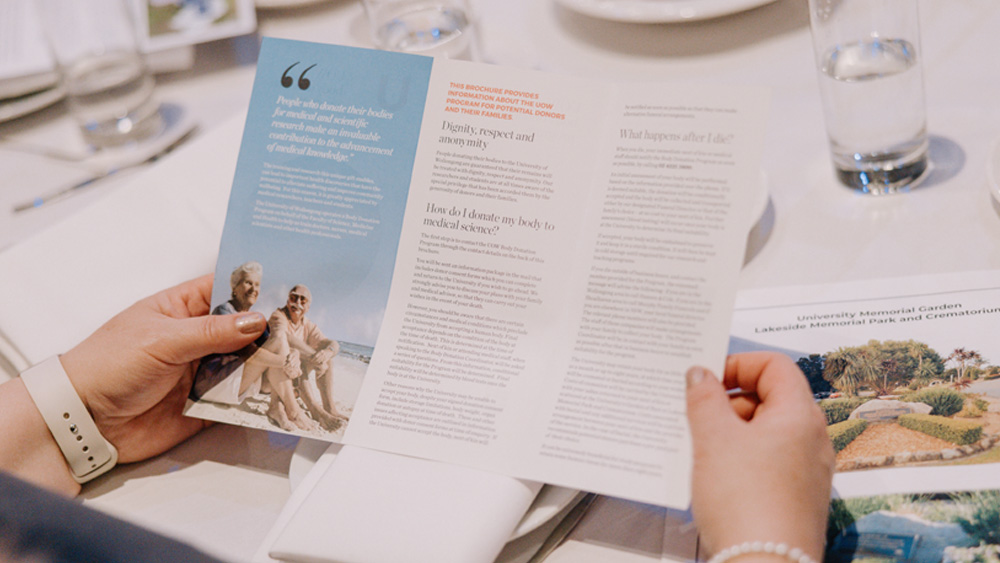
How does donation work?
In addition to extensive NSW Health regulations that the program needs to follow, UOW staff aim to provide donors and their families with as much dignity as possible.
“When someone has died,” says Professor McGhee. “It's a heightened emotional time and we try to support the families through this process."
Prior to their death, prospective donors need to complete a comprehensive registration form to give their consent. The program won’t accept donations from next of kin of deceased loved ones, only taking donations that were registered during their lifetime.
For clarity and complete transparency, the Body Donation Program provides extensive information on the process and a checklist to help prospective donors prepare themselves and their families. For example, there are conditions where the University is unable to accept the body due to NSW Health regulations (e.g. death due to infectious diseases).
“We try to be absolutely transparent,” says Professor McGhee. “There are rules we must follow and we want donors and their families to know them upfront, so they are prepared. We also provide them with opportunities to ask any questions or discuss any concerns they or their families have with our program coordinator.”
Once a registered donor passes away, their next of kin or medical staff member needs to contact the program coordinator as soon as possible. If they are able to accept the donation, the University organises for the donor to be collected and transported to the University at no cost to the next of kin.
Professor McGhee explains that while it’s rare for a donated body not to be accepted, program staff are committed to making these conditions and potential scenarios clear to donors and their families, to make the process as smooth as possible for grieving loved ones.
What happens once a body is accepted?
Once bodies are embalmed, our skilled technical staff prepares prosections, which are parts of a cadaver that are carefully dissected to highlight key anatomical features so students can see them clearly.
These prosections are used in anatomy classes for students in the Graduate School of Medicine and the School of Medical, Indigenous and Health Sciences, under strict guidelines that ensure remains are treated with dignity, respect and anonymity at all times.
“We also run anatomy sessions for year 11 students from about 30 high schools in the region,” says Professor McGhee. “They come here for one session for their Personal Development, Health and Physical Education subject. We’re very careful about what we show them, but they get to see some cadaveric anatomy and they are absolutely fascinated.”
Donated bodies are also used in research, but Professor McGhee stresses, "the primary use is education. We only let the lab be used for research when we have sufficient resources for our education."
This may include providing a safe environment for doctors to try a procedure or research a new technique, yet any external researchers coming into the anatomy lab must always be supervised by a UOW academic, and they must follow strict rules around what they’re allowed and not allowed to do with the prosections.
That’s not to say vital research isn’t happening in the anatomy lab. Professor McGhee recalls the work of one of her higher degree research students, Katie Gaskin, who went on to study in UOW’s Graduate Medicine Program: “In 2020, she dissected the male and female breast anatomy, and it was the first time that the fibroadipose structure of the female breast had ever been dissected.”
Professor McGhee notes the research impact is often the result of the spark of interest and passion ignited by their foundational anatomy classes.
"Many students go on to do applied medical research based on anatomy, not necessarily cutting up a cadaver, but using the anatomical science they've learned and applying that to medical research."
How long are bodies kept and what happens then?
Legally, the University is allowed to retain a body for teaching and research for four years and can then apply to be able to retain it for a further four years.
Once the University has completed anatomical examination of a body, remains are either cremated or buried according to the wishes of the donor outlined in their original registration form. The University covers the cost of cremation, with ashes collected in person by the next of kin or scattered at UOW’s Garden of Rest at .
There is a foundation stone which pays tribute to all those who have donated their bodies to the Body Donation Program and small plaques commemorating each individual whose ashes have been scattered in the garden.
A memorial book lists everyone who has donated to the program, with names added annually by a local calligrapher. The closed book is on display in the Graduate School of Medicine foyer, placed on a stand that was made from recycled materials by a local woodworker in honour of the program’s 10th anniversary in 2015.
“The majority of our donors are within 200 kilometres of UOW,” says Professor McGhee. “This really is the local community giving back and benefiting the community.”
Honouring donors and their families
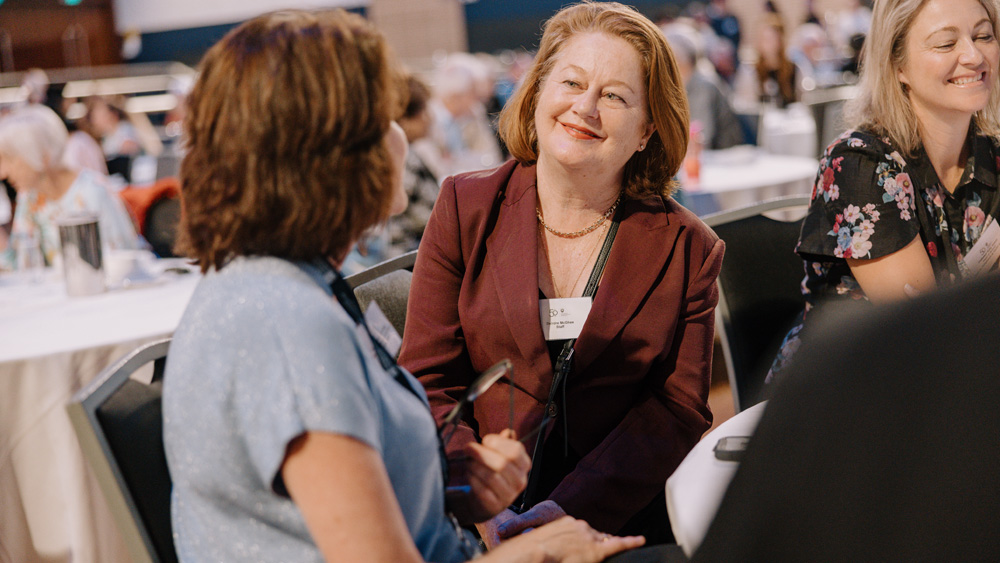
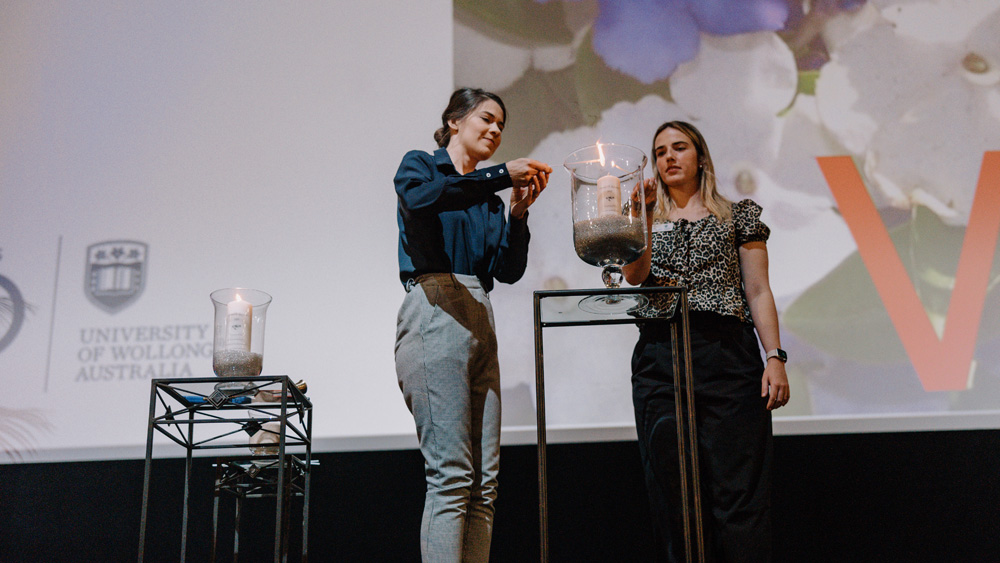
Bringing that community together every two years, the University hosts a Ceremony of Appreciation to honour those who have donated and their families.
“It is both a privilege and an honour to share this occasion of remembrance, gratitude, and reflection with you,” said , UOW Anatomy Licensee, at the November ceremony which also marked a milestone anniversary for the program.
"For 20 years, the University has gratefully accepted each donation into our care, with a deep sense of responsibility to honour, protect, and pass on this gift to the next generation of health professionals and scientists. Your presence, support, and trust make this program possible."
For families, it is a chance to remember their loved ones and see the impact their donation has made.
"Mum had very limited opportunities for education as a child and young woman,” said one attendee. “When she was dying, she said: ‘now I have donated my body to the University of ÌìÃÀ´«Ã½, at the age of 93, I will finally be going to university’. We are so proud of mum and the example that she set for us, that my husband and I have also registered to donate our bodies when we pass."
Another attendee described his late father’s love of volunteering, and the opportunity the program gave him to continue volunteering after he had died: “We are very proud of dad and of our mum who is also a registered donor. Coming to the ceremony helps us to support mum in her decision and to honour our dad. Listening to the speakers today we all feel that dad was on the right path and that donating his body was the right thing to do."
It is also an opportunity for families of prospective donors to gain a deeper understanding of why their loved one has chosen to give their body to medical science, particularly those that might be a bit unsure or uneasy about the decision.
As well as having a chance to ask questions of staff and students, attendees hear from two student speakers that have directly benefited from the program, sharing their appreciation for the opportunities it has given them, including Cathryn Brown (graduate medical student) and PhD candidate Cassandra Russell.
"We all want to contribute and feel like we’ve succeeded somehow in life, in our families, our workplaces and our communities,” said Ms Russell. “Whatever that means to you, and whatever legacy that you have or have not left, your decision to be in our program is one of just that – legacy. Your decision is one that has and will help many students just like me go on to live and think bigger, to appreciate awe and wonder, to be thankful for the gifts of others, and to go on and leave legacies of their own."
“The student speakers had a great impact on me and reinforced my decision,” said one registered donor at the event. “The values of the students, their education and their future careers inspired me, and I am grateful for the opportunity to leave a legacy to the world. Being part of the program enables me to fulfill the circle of life. Giving my body to the UOW Body Donation Program can help to save future lives by contributing to medical science."